Skip to content

Posts by Pairach

Presenting Research Orally


Tips

  • Prepare your presentation for your audience – what do they know before hand?
    This should determine language you will  use i.e., use of jargons, terminology.
    Also this will reflect their interest, what do they want to know from your presentation.
  • Speaking  is inefficient method of communicating relatively to writing. Hence you need to cut out the unnecessary from the presentation.
  • Normal speed of speaking in presentation ~ 120 -150 words per minute = 25% slower than normal speaking.
  • Therefore in 10 minutes, maximum number of words you can cover = 15o x 10 = 1,500 words
  • Give preparation time before presentation i.e., checking presenting equipment facilities

Visual aids

  • Number of slides
    Rules depend on the disciplines
    History may be just 5 slides for 30 minutes
    I n scientific one would be around 1 slide per minute  (+ intro and Q&A).
  •   Visual aids can be used for the following function either “Drivers” or :Supplementary” or “Explanatory”.

Style of Presentation

Introduction

  • Name (unless the chair has already introduced you)
  • Thanks – Chair, audience
  • Title of Research
  • Acknowledgement (or at the end of presentation)
  • Broad scope of presentation including what you won’t cover but may be expected the the audiences

Opening

  • Short hook
    – Asking question
    – Quotation
    – Refer to the current affair (especially in social science)
    – Statistics related to the subject
  • Aims and Objectives
  • 1 – 1.5 minutes for Introduction + Opening

End (summary and then conclusion)

  • Summary = reiterate what have been presented already, not the new things.
    in bullet points
  • Conclusion: Includes comments and suggestion of the future works.
    – short punchy phrase

Gesture and Body language

  • Gaze – eye contact
    – You can look down to your note but don’t speck during that time, just pause. Speck after you look up  again.
    – Use your eye contact like a lighthouse
    – Don’t look at other things, focus on your audiences.
    – Don’t pat too much attention on a particular person e.g., experts or persons who nodding their heads all the time.
  • Whole body orientation
  • Posture
  • Gesture  – hands/arms
    – Show your hands to people
    – get your hands in fornt of you
    – Don’t over gesture. bring your hands back to the focal point (e.g., stand or note or other object)
    – If you use cards, put numbers on them and stick them together so that you will not mess them when you drop them.
    – Use open-palm gesture as it is the normal gesture that doesn’t offense anyone.
  • use of space

Tips for questions

  • Offer to deal with the details afterwards
  • Be prepared to concede
  • Useful expression “It’s a case that we may have to agree to disagree”.
  • Keep calm and don’t take it personally
  • Do not comment on anything outside your area of expertise
  • Use the experts in the audience
  • If no question, you may ask yourself. “This is the question that I have been asked previously”.

Time Management Tips


Tips

  • Create a to-do list
  • Having small tasks in the list rather than a big one. Therefore you can tick those taks off easier
  • Prioritise the tasks based on their “Importance” and “Emergency”.
  • Here is the suggested priority (ranked by Urgent then Important
    1. Urgent and  important
    2. Urgent but not important
    3. Not urgent but important
    4. Neither urgent nor important
  • Be flexible -> Plan for unplanned things. Don’t fill all the slot in the whole day, give some room for emergency.
  • A bit under-estimate yourself on how long it would take to finish the task. If you think the task would take 2 hours, you may put 2.5 or 3 hours on the list/diary.
  • Don’t forget the small things that relates to the task e.g., travelling time.
  • Pomodoro technique (Pamodoro = Italian for tomato) -> Working in blocks of 25 minutes.
  • More info in the Website PomodoroTechnique.com
  • and the book as below (click the picture to see on Amazon)
  • Pomodoro technique suggests you to just focus on only one task in the slot of 25 minutes (or the amount of time that fit you).
  • Vitae Booklet “Balanced Researcher” (PDF)
  • Priority is moving around i.e., things getting more urgent or more important. Thus long term plan needed!
  • Know when you are the most effective and not the active. Allocate tasks accordingly.
    e.g., If you are a bit lazy during 3-4pm of the day, assign yourself small taks during that time.
  • Your head/brain is like a hard drive. Don’t put too much in there unless its processing will get slower and slower. Organise and Re-organise your data, information, tasks.
  • Dare to put unnecessary stuffs into the trash.
  • Create waiting list, next action with specific required time and deadline.
  • Using Calendar to organise … sync with your mobile device if you have or consider Cloud based application.
  • Email tip … if you can finish it within 2 minutes, then do it now and delete it. If it requires > 2 minutes, put it in the waiting list. Subject to how urgent it is.
  • Time wasters! -> You need to have your own time for things you love … hobby, sports, Internet or Social Network Site. They are not time wasters as they make your life more lively unless you overspend your time on them. Hence balance them with your duty, prioritising and stick with it.
  • Learn to say “No” to things that are not necessary or will make your life difficult or will mess up your schedule/priorities.
  • Don’t check your Email/Social Network first, do your planned task on the day first.
  • If you need concentration, create such environment … turn off distractions e.g., email notifications, TV if they are so.
  • Remember that it’s not always gonna be a perfect day, prepare for it!

Where to get a PhD?


PhD study is mainly about how to do a research. It normally takes more than three years to complete the course. Many PhD candidates have withdrew or failed in the end. I found that on of the root causes is that ‘Students are fail to select the right place to study’.

Based-on my experience I decided to study PhD with Professor Stephen Disney at Logistics Systems Dynamics Group, Cardiff Business School because of the following factors.

  1. Supervisor(s)
    This is the most important factor. Choose your supervisor wisely since switching one is difficult and costly in terms of time, effort and moral.
    – You should be able to work with your supervisor effectively and efficiently. Think that you can work with him/her for at least 3 years
    – Your supervisor should know either the subject or the method of your PhD proposal or both. If you are lucky, you may find two supervisors who are experts in subject and method in the supervisory panel.My primary supervisor is a quantitative professor in operations management and my secondary supervisor got a nationwide award on her qualitative PhD thesis. Hence, I am very lucky!
  2. Research Group / Academic Section
    Doing PhD in a well-supporting research group or academic section will help you financially and academically. Choosing a research group which is one of the leading group in the subject will give you an opportunity to learn from other group members and fellow PhD students as well.My research group, Logistics Systems Dynamics Group, is a leading logistics and supply chain in the UK and Europe.
  3. Schools / Faculty
    Similar to research group, choosing a right school or faculty, you will study in the right environment. This is quite significant for PhD in Logistics and Supply Chain Management. You may go for business school or engineering one or even economics. The decision perhaps depends on your research methods. Please note that you may find many engineering researchers in some business schools and  vice versa.Cardiff Business School is ranked 4th in the UK in term of research quality!
  4. University
    Studying in a great university will offer you a cross-disciplinary knowledge and experience. At Cardiff University, I have had a great chance to learn such a rigor social science research methods from School of Social Science and another view of logistics and transports from the School of City and Regional Planning as both are the best in the UK. Moreover, Cardiff University is one of 20 Doctoral Training Centre in the UK.
  5. City / Country
    Not only study but you also have to live happily whilst you are study. PhD is a long journey. Living in a nice place will improve your quality of life, reduce stress from study. Moreover, choosing a place where you can learn outside the university is also important.Cardiff was the biggest marine port in the world. Now, the city is very well developed. Welsh people are very nice too. The living cost is also relatively lower than other big cities in the UK.
Albeit based on my experience, these five factors are from my own experience, one may find them useful when considering where to do a PhD. Think well since you have to be there for three years or more!

Quick Scan in Australiasia


Guest Lecture to Service Operations Research Theme (SORT), Cardiff Business School
QSAM in Australiasia
QSAM: Quick Scan Audit Methodology 

by Dr Eric Deakins from University of Waikato, New Zealand

19 October 2011

Industry fieldwork with NZ value stream

Objectives: 

  • Understand barriers to seamless flow within the NZ context
  • Identify SC issues

Labour productivity in NZ was quite low during 2005-2008

  • Relatively low productive comparing to OECD countries, work more than the output
  • Around 10%GDP of business investment , lower than OECD average

Full QSAM sample

  • NZ commodity
  • Large daily factory
  • Large (global-brand( pulp and paper producer
  • Med. 3PL

NZ non-commodity

  • Med. kitchen manufacturer
  • Large (global brand) food producer etc.

Results

  • International integration comparison: baseline, functional integration, internal integration and external integration
  • an issue is to get the client interested in improving their integration level

Case study

  • Bad case:
    Cause-Effect -> no strategic plan and direction, reply solely on cost as a single KPI, reliance on tacit knowledge resulting in decline profitability
  • Identify barriers to SC integration using three layer framework, from outside to inside = environment, company and value steam from (Bohme et al., 2009) and four type classification from Cardiff BPR, culture, technology, finance and organisation
  • define the scale of each classification (Cardiff BPR) by low, med and high
  • Output (PhD thesis) supply chain improvement path way -> change programe (attempt to improve)

Pathway of least resistance: 

  • Starting from people and then integrate internally and externally simultaneously
  • Key moderator for internal process – top management support
  • Key moderator for external relationship integration are positive power and dependency structure
  • Applying technology in the end of both internal and external integration

Reflection

1. People

  • “Once we were warriors”
    – Deep down they still are
    – Male dominance
  • Win-Win is for wimps
    – Competitive mind. just interact in the business and move on
  • “Once were pioneers”
  • “This is NZ so [obviously] our needs are unique”
  • Industry and academia are like oil and water
    – Most mid and top level managers don’t have a degree, just learned from their jobs
    – Then, they are not interested in the business
    – “I learned all that I wil ever need on the job”
    – “We made 2.4 billion last year”

2. The Place

  • NZ is unpopulated – “Everyone knows everyone”
  • NZ living is relatively uncomplicated
  • NZ is a very risk-averse society
  • NZ is broke (es.. Since Christchurch earthquakes)
  • NZ has poor logistics and transport infrastructure and all modes aggressively compete with each other
    – No productivity strategy, “let the market decide”
  • Government is populist and prone to knee-jerk reaction
    – 3-year term; MMP system

3. A longstanding focus on effieciency

  • “This plant is running at 110%”
  • “We couldn’t stop the paper mill even if we wanted to; after 52 years of operation no-one would know how to restart it”
  • “Every fire station, warehouse and unused cool store for 50 miles around is full of our product”
  • “When we restart the furnance the lights dim in the local supermarket and the EFTPOS machines  go down.

4. The Perspective

  • NZ is very remote from its markets
    – Parochial, cliquey, ‘Us and them’
  • very small or far away?
  • the long view – ‘3D narrow’ versus ‘2D wide’

Research avenues

How to increase QSAM impact/effectiveness/reputation?
Post-QSAM Impact (0-10)
Dairy company = 8
Pulp/paper mill = 5
3PL = 1
Kitchen manufacturer = 3
Food producer = 3
Machinery manufacturer = 7
Hospital = 1
Foundry = 0
Average = 3.5 

Improvement alternative
1. Aspirin – Quick Hit – short term not sustainable
2. Sustainable way – operational efficiency

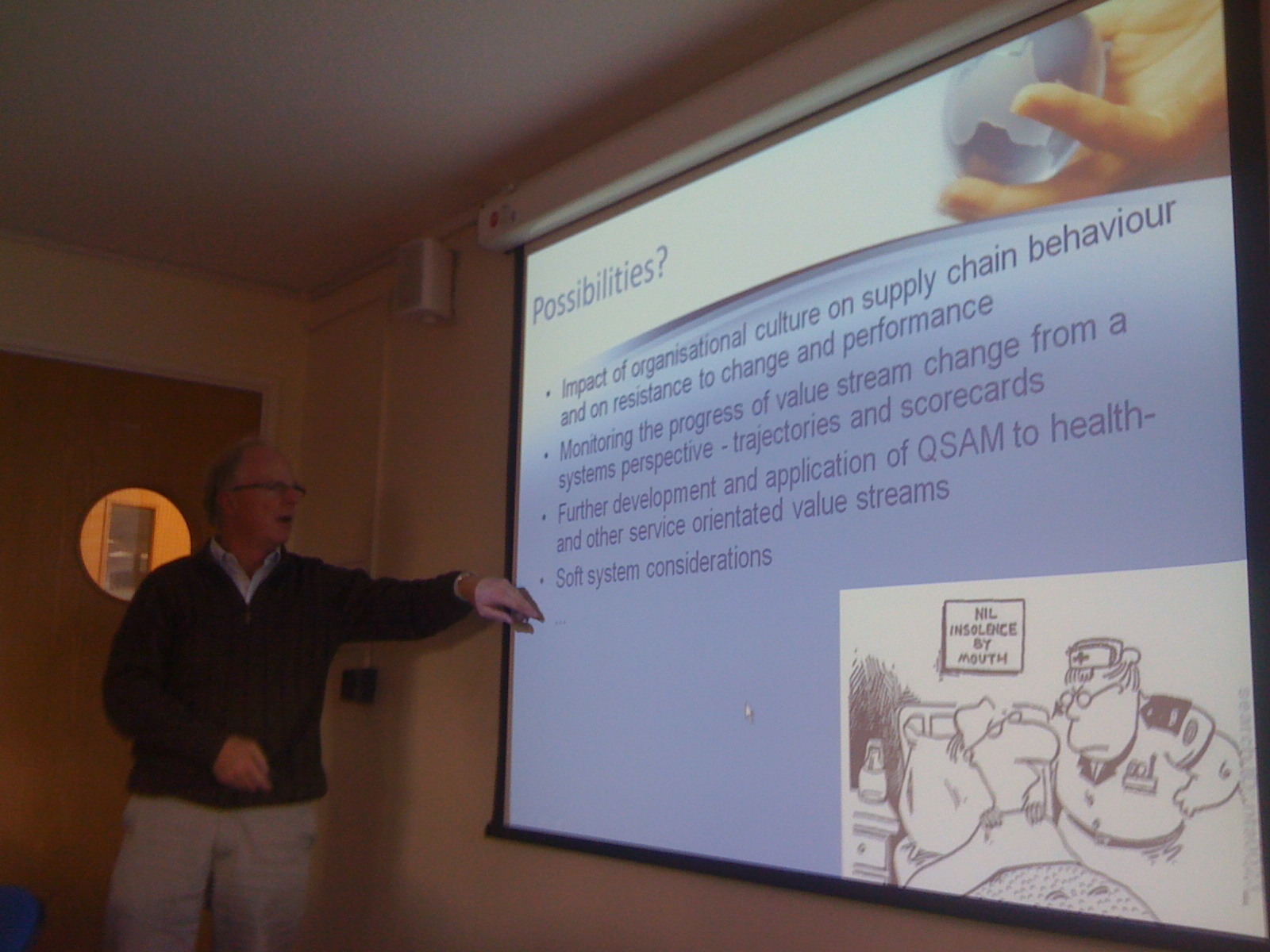
Possibilities

  • Impact of organisation culture on supply chain behaviour and on resistance to change and performance
  • Monitoring the progress of value stream change from a system perspective – trajectories and scorecards
  • Further development and aplication of QSAM to health and otherservice orientated value streams
  • Soft system considerations

Econometrics with R – Part2


R นั้นเป็นโปรแกรมที่เหมาะที่จะวิเคราะห์ข้อมูล การป้อนข้อมูลเข้าวิเคราะห์ใน R นั้นจึงนิยมทำในโปรแกรมอื่นก่อน เช่น ใน spreadsheet (MS Excel) หรือ SPSS แล้วค่อยนำเข้า (Import) ข้อมูลดังกล่าวเข้ามาวิเคราห์ใน R โดยสามารถทำได้โดยใช้ command ด้านล่างนี้

1. จากไฟล์นามสกุล .csv

สมมุติว่าต้องการนำเข้าไฟล์ data.csv
โดยแถวแรกของข้อมูลนั้นเป็นชื่อตัวแปร

data <- read.table("c:/data.csv",
header=TRUE,
sep=",",
row.names="id")

2. จาก MS Excel

ให้  export ไฟล์ออกมาให้อยู่ในรูป .csv แล้วทำตามข้อที่ 1.

3. จาก SPSS หรือ  PASW (IBM)

ให้  export ไฟล์ออกมาให้อยู่ในรูป .csv ก่อน
โดยใช้คำสั่ง “Save as” แล้วเลือกนามสกุลของไฟล์เป็น .csv
จากนั้นทำการนำเข้าข้อมูลไปในโปรแกรม R ตามข้อที่ 1

4. จาก Stata

library(foreign)
data <- read.dta("c:/data.dta")

ตัวอย่างการเลือกตัวแปรเพื่อสร้างฐานข้อมูลย่อย (sub_data) จากฐานข้อมูลหลัก (data)

โดยสามารถเลือกตัวแปรได้โดยการ คลิ๊ก ร่วมกับ Shift (เลือกช่วงตัวแปร) และ Ctrl (เลือกทีละตัว)

data <- data.frame(replicate(26,list(rnorm(5))))
names(data) <- LETTERS
sub_data <- data[select.list(names(data), multiple=TRUE)]

Source: Adapted from an answer of  Josh O’Brien in Stackoverflow to the question from  Jeromy Anglim

กลับสู่สารบัญ

Related posts