Recently British government (by Office of National Statistics: ONS) just published their version of R manual for analysis of the government survey. The links to PDF and MS word versions of the manual including the R syntax are as below.
Note: The R syntax link is not working now. I am contacting the ONS, hope they will fix it soon.
The R Guide to ESDS Large-Scale Government Surveys PDF, Word
For the US governemnt, there is an emerging awareness and recognition of the power of R in their Big Data Initiative. David Smith (Revolution Analytics) has summarised the application of R in the US governemnt in his post here.
Most WordPress BloggeRs are using this text highlight syntax, some are not.
I hope that this post would be a reference source for new WordPress BloggeRs for posting their R code on their blog posts.
According to an official guide by WordPress.com on “Posting Source Code“, To post R code in the WordPress.com, just wrap R code as follows (without “#” in both wrappers):
From above, before your R code put the command in line 1, or [#sourcecode language=”r”], but without #
Then, place your R code (line 2-4).
End the code box by put the command line as in line 5, but without # or “[/sourcecode]“
Then the code will appear as following.
Your R code and comments
x <- rnorm(100)
y <- x + 10
Moreover, more options can be configured to better describe the code efficiently.
autolinks (true/false)
TRUE: Makes all URLs in your posted code clickable.
Defaults: TRUE
collapse (true/false)
TRUE: The code box will be collapsed when the page loads, requiring the visitor to click to expand it.
Comment: Good for large code posts.
Defaults: False.
firstline (number)
Comments: Use this to change what number the line numbering starts at
Defaults = 1
gutter (true/false)
TRUE: Show the line numbering on the left hand side.
FALSE: The line numbering on the left side will be hidden.
Defaults = TRUE
highlight (comma-seperated list of numbers)
You can list the line numbers you want to be highlighted.
Example = “4,7,19″.
htmlscript (true/false)
TRUE: Any HTML/XML in your code will be highlighted.
Comment: This is useful when you are mixing code into HTML, such as PHP inside of HTML.
Defaults = FALSE (only work with certain code languages)
light (true/false)
TRUE: The gutter (line numbering) and toolbar (see below) will be hidden.
Comment: This is helpful when posting only one or two lines of code.
Defaults = FALSE
padlinenumbers (true/false/integer)
TRUE: Automatic padding
FALSE: No padding, and entering a number will force a specific amount of padding.
Comment: Allows you to control the line number padding.
toolbar (true/false)
FALSE: The toolbar containing the helpful buttons that appears when you hover over the code will not be shown.
Defaults = TRUE
wraplines (true/false)
FALSE: Line wrapping will be disabled. This will cause a horizontal scrollbar to appear for long lines of code.
EURO 2012 winning probabilities from the bookmaker consensus rating.
The figure below show the probability that Team i will beat Team j, calculated by this formula;
Pr (Team i beat Team j) = (Ability of Team i) / (Ability of Team i / Ability of Team j)
Winning probabilities, that Team i will beat Team j, in pairwise comparisons of all EURO 2012 teams
As an Econometrician and a football fan, I really like this paper and wish I can replicate their work for the tournament related to my home country team, Thailand.
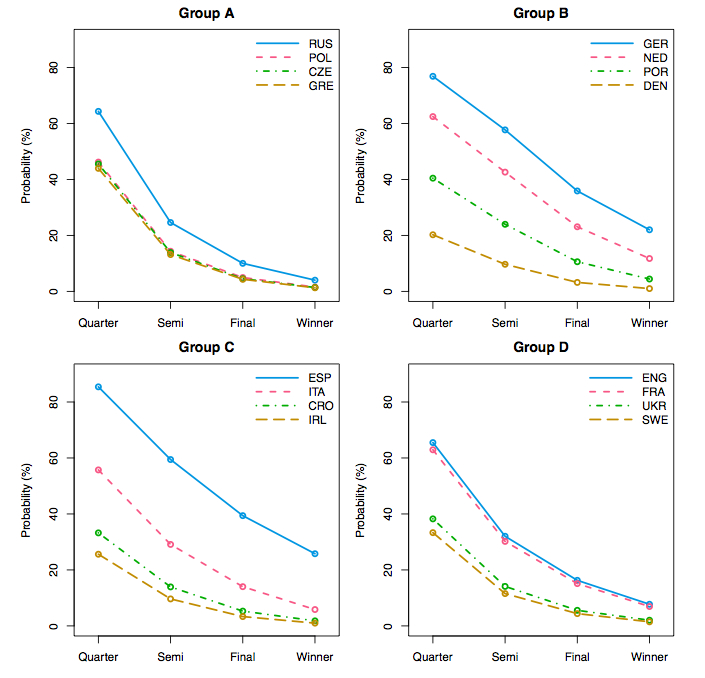
Probability for each team to survive in the EURO 2012 ,i.e., proceed from the group-phase to the quarter finals, semi-finals, the final and to win the tournament.
The paper details are as follows.
Achim Zeileis, Christoph Leitner, Kurt Hornik (2012). History Repeating: Spain Beats Germany in the EURO 2012 Final. Working Paper 2012-09, Working Papers in Economics and Statistics, Research Platform Empirical and Experimental Economics, Universität Innsbruck.
Abstract
Four years after the last European football championship (EURO) in Austria and Switzerland, the two finalists of the EURO 2008 – Spain and Germany – are again the clear favorites for the EURO 2012 in Poland and the Ukraine. Using a bookmaker consensus rating – obtained by aggregating winning odds from 23 online bookmakers – the forecast winning probability for Spain is 25.8% followed by Germany with 22.2%, while all other competitors have much lower winning probabilities (The Netherlands are in third place with a predicted 11.3%). Furthermore, by complementing the bookmaker consensus results with simulations of the whole tournament, we can infer that the probability for a rematch between Spain and Germany in the final is 8.9% with the odds just slightly in favor of Spain for prevailing again in such a final (with a winning probability of 52.9%). Thus, one can conclude that – based on bookmakers’ expectations – it seems most likely that history repeats itself and Spain defends its European championship title against Germany. However, this outcome is by no means certain and many other courses of the tournament are not unlikely as will be presented here.
All forecasts are the result of an aggregation of quoted winning odds for each team in the EURO 2012: These are first adjusted for profit margins (“overrounds”), averaged on the log-odds scale, and then transformed back to winning probabilities. Moreover, team abilities (or strengths) are approximated by an “inverse” procedure of tournament simulations, yielding estimates of all pairwise probabilities (for matches between each pair of teams) as well as probabilities to proceed to the various stages of the tournament. This technique correctly predicted the EURO 2008 final (Leitner, Zeileis, Hornik 2008), with better results than other rating/forecast methods (Leitner, Zeileis, Hornik 2010a), and correctly predicted Spain as the 2010 FIFA World Champion (Leitner, Zeileis, Hornik 2010b). Compared to the EURO 2008 forecasts, there are many parallels but two notable differences: First, the gap between Spain/Germany and all remaining teams is much larger. Second, the odds for the predicted final were slightly in favor of Germany in 2008 whereas this year the situation is reversed.
Providing 14 R Style Rules including filenames, identifiers, indentation, spacing etc. “These rules were designed in collaboration with the entire R user community at Google”
Developed since 2002. It’s version 0.9 (January 2009)
Please read this message in the introduction part before applying this coding convention.
” Please note that this document is under construction since mid October 2002 and should still be seen as a first rought draft. There is no well defined coding recommendations for the R language [1] and neither is there a de facto standard. This document will give some recommendations, which are very similar to the ones in the Java programming style [2][3], which have found to be helpful for both the developer as well as the end user of packages and functions written in R.“
Here is what he mentions in the introduction.
“Good coding style is like using correct punctuation when writing: you can manage without it, but it sure makes things easier to read. As with punctuation, there are many possible variations, and the main thing is to be consistent. The following guide describes the style that I use – you don’t have to use it, but you need to have some consistent style that you do follow. My style is based on Google’s R style guide, with a few tweaks.Good style is important because while your code only has one author, it will usually have multiple readers, and when you know you will be working with multiple people on the same code, it’s a good idea to agree on a common style up-front.”






 Pairach Piboonrungroj, PhD